Texas has the highest uninsured rate in the country. Most people are not uninsured by choice. They are confused about their options, unsure what things cost, or they missed an enrollment window.
This guide gives you the facts you need to choose private health insurance in Texas with confidence. Wilkerson Insurance Agency has been helping Texas residents find coverage from its office in Farmers Branch, TX since 2010.
What Is Private Health Insurance in Texas?
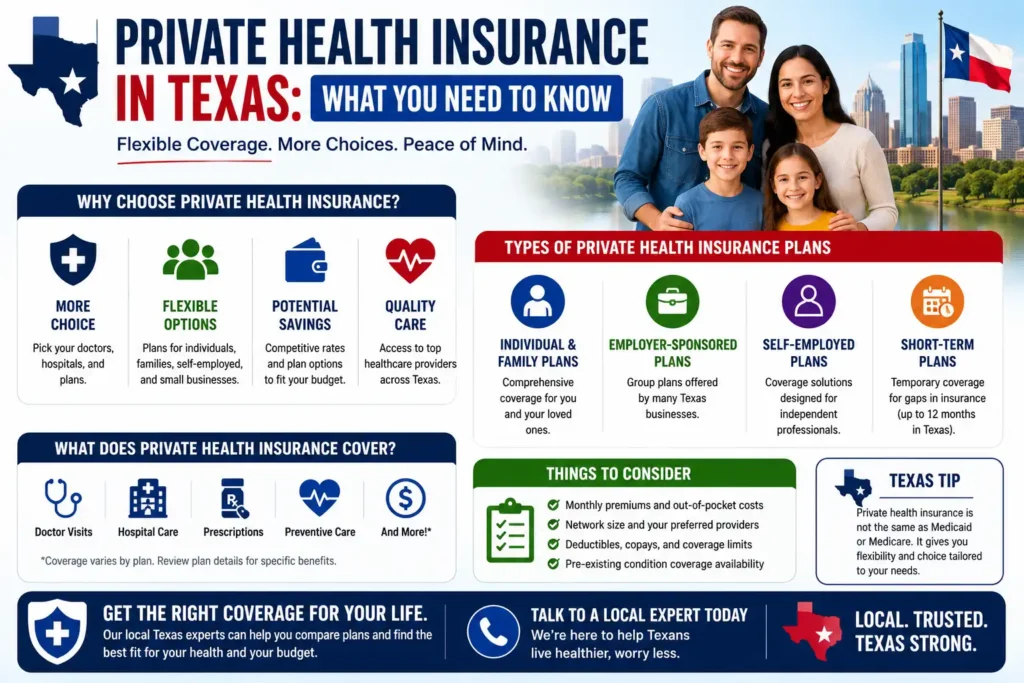
Private health insurance is coverage you buy from a commercial insurer, not through a government program like Medicaid or Medicare. In Texas, you can get it through an employer, directly from an insurer, or through the federal Health Insurance Marketplace at healthcare.gov.
Private does not mean unaffordable. Many Texas residents qualify for Premium Tax Credits through the Affordable Care Act that reduce monthly costs significantly. Private insurance also gives you more control over your network, deductible, and provider choices.
ACA Subsidy InformationIt is the primary coverage option for self-employed Texans, small business owners, gig workers, and anyone between jobs.
What Types of Private Health Insurance Plans Are Available in Texas?
HMO (Health Maintenance Organization)
You choose a primary care physician who manages your care and refers you to specialists. HMOs have lower premiums and lower out-of-pocket costs, but you must stay in-network. Out-of-network care is not covered except in emergencies.
PPO (Preferred Provider Organization)
No referrals needed. You can see any doctor or specialist, in-network or out. Out-of-network care costs more, but you have the flexibility. PPOs carry higher premiums and are popular with families and anyone managing ongoing health conditions.
EPO (Exclusive Provider Organization)
No referrals needed, but you must stay in-network. There is no out-of-network coverage except emergencies. Premiums sit between HMO and PPO levels.
HDHP (High-Deductible Health Plan) with HSA
Lower monthly premiums, but you pay more out of pocket before coverage kicks in. These plans pair with a Health Savings Account (HSA), which lets you save pre-tax dollars for medical expenses. Learn more about maximizing HSA benefits to get the most from this option.
For a detailed comparison of these plan types, see our guide on HMO vs PPO vs EPO vs POS plans.
| Plan Type | Referrals Required | Out-of-Network Coverage | Best For |
|---|---|---|---|
| HMO | Yes | No | Lower costs, in-network care |
| PPO | No | Yes (higher cost) | Flexibility, specialist access |
| EPO | No | No | Mid-range cost, no referrals |
| HDHP + HSA | Varies | Varies | Healthy individuals, tax savings |
How Much Does Private Health Insurance Cost in Texas?
Monthly Premiums
A Silver-tier plan for an individual in their 30s typically runs $350 to $550 per month without a subsidy. A family of four can expect $1,100 to $1,800 monthly. If your income qualifies, ACA subsidies can bring these numbers down sharply. Some Texas residents pay under $100 per month after tax credits.
Deductibles
Understanding how deductibles work is crucial to choosing the right plan:
- Bronze plans: $5,000 to $8,000 individual deductible
- Silver plans: $2,000 to $4,500
- Gold and Platinum plans: lower deductibles, higher premiums
Out-of-Pocket Maximum
The most you pay in a plan year before insurance covers 100% of costs. For 2024 ACA plans, the limit is $9,450 for individuals and $18,900 for families.
What Affects Your Rate
- Age
- Tobacco use
- Plan tier (Bronze, Silver, Gold, Platinum)
- Location (DFW rates differ from rural Texas)
- Number of people covered
Income determines subsidy eligibility but does not directly change your premium. A broker can calculate your net cost after tax credits.
When Can You Enroll in Private Health Insurance in Texas?
Open Enrollment Period
Marketplace enrollment runs November 1 through January 15. Coverage starting January 1 requires enrollment by December 15. Plans enrolled between December 16 and January 15 start February 1. Learn more about what Open Enrollment means for your planning.
Special Enrollment Period (SEP)
You qualify for a 60-day enrollment window after a qualifying life event:
- Losing job-based coverage
- Getting married or divorced
- Having or adopting a child
- Moving to a new coverage area
- Turning 26 and aging off a parent's plan
Important: Missing Open Enrollment without a qualifying event means waiting until the next cycle. If you missed the deadline, read our guide on getting health insurance after Open Enrollment ends.
For current enrollment options, see Wilkerson's individual and family health insurance page.
How Do You Compare Private Health Insurance Plans in Texas?
Plan Comparison Checklist
Check your doctors first. Confirm your current physicians are in-network before you look at the price. A cheaper plan that excludes your doctor costs more in practice.
Estimate your annual healthcare use. Light users often do better with an HDHP and lower premium. Regular doctor visits and prescriptions favor a Gold or Silver plan with lower cost-sharing.
Calculate total annual cost, not just premium.
Total Annual Cost = (Monthly Premium x 12) + Expected Out-of-Pocket Costs
A $400 premium plan with a $6,000 deductible you expect to hit costs roughly $10,800 per year. A $550 plan with a $2,500 deductible costs about $9,100. The higher-premium plan is cheaper for that person.
Check prescription coverage. Every plan has a formulary listing covered medications by tier. Tier placement affects your copay for each prescription.
Read the Summary of Benefits and Coverage (SBC). Every plan must provide this document. Focus on the deductible, out-of-pocket maximum, copays, and any exclusions.
For a comprehensive checklist, review these ten questions to ask before picking a health insurance plan.
What Does a Health Insurance Broker Do in Texas?
A broker works for you, not for any single insurer. They have access to multiple carriers, compare options across the market, and are paid by the insurer at no cost to you.
The practical benefit is accuracy and time saved. Brokers check network availability, calculate subsidy eligibility, and explain plan trade-offs in plain language. They also help when billing issues come up or when your situation changes.
For business owners, brokers handle group health insurance plans from carrier selection through employee enrollment. Learn more about how small businesses benefit from group health insurance.
Ready to compare your options?
Wilkerson Insurance Agency serves the Dallas-Fort Worth area.
Wilkerson Insurance Agency serves the Dallas-Fort Worth area including Farmers Branch, Carrollton, Coppell, and Irving. Call 214-501-9613 or request a quote.
Why Wilkerson Insurance Agency Is the Right Choice for Private Health Insurance in Texas
Wilkerson Insurance Agency has served Texas residents since 2010. Here is what sets the agency apart:
Not tied to one company. Recommendations are based on your needs, not commission.
Deep knowledge of carriers, networks, and subsidy rules.
Health, dental, vision, Medicare Supplement, life insurance, and disability income all in one place.
You work with an advisor who knows your situation.
Trusted by Texas families and business owners across the DFW area.
Frequently Asked Questions
Find the Right Plan for Your Situation
The right private health insurance plan in Texas comes down to which plan type fits how you use healthcare, whether the total annual cost makes sense, and whether you have the right guidance.
Request Your Free Quote →Wilkerson Insurance Agency in Farmers Branch, TX has been helping Texas residents make that decision since 2010. Call 214-501-9613 or contact us.