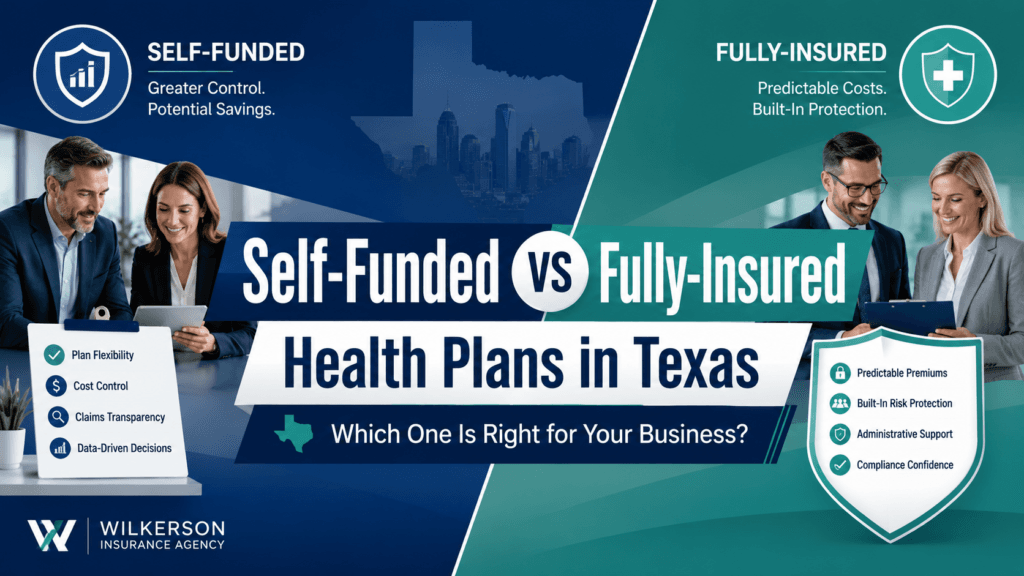
Choosing the right health plan structure is one of the most important financial decisions a Texas employer can make. The choice between a self-funded vs fully-insured health plan affects your monthly costs, your cash flow, your risk exposure, and how much control you have over employee benefits.
Most employers in Texas default to a fully-insured plan because it feels simpler. But for many businesses, that simplicity comes at a cost. Self-funded plans have grown significantly among mid-size Texas employers precisely because they offer more flexibility and, in many cases, lower long-term spending.
This guide breaks down both options in plain language so you can make a confident, informed decision.
How Does a Fully-Insured Health Plan Work in Texas?
A fully-insured plan means your business pays a fixed monthly premium to an insurance carrier. The carrier assumes all financial risk for employee claims. If claims are low one year, the insurer keeps the savings. If claims are high, the insurer absorbs the loss.
The premium is set in advance, usually for a 12-month period, and is based on your group's age, size, and health risk profile. You know exactly what you will pay each month, which makes budgeting straightforward.
For small businesses in Texas, fully-insured plans are often purchased through the ACA marketplace or directly from carriers like Blue Cross Blue Shield of Texas, Aetna, or United Healthcare.
Key Characteristics of Fully-Insured Plans
- Fixed monthly premium regardless of actual claims
- Carrier handles all claims processing and administration
- Subject to Texas state insurance mandates and ACA requirements
- Easier to administer, especially for HR teams without benefits expertise
- Less flexibility to customize plan design
This structure works well when predictability matters more than cost optimization. However, businesses with a generally healthy workforce often overpay under this model because they are subsidizing the insurer's risk pool.
If you want to review your current group health options, the group health insurance plans page at Wilkerson Insurance Agency is a useful starting point.
How Does a Self-Funded Health Plan Work?
With a self-funded health plan, your business pays employee claims directly rather than paying a fixed premium to a carrier. You take on the financial risk of covering claims, but you also keep any money left over when claims come in lower than expected.
Most self-funded employers hire a third-party administrator (TPA) to handle claims processing, network access, and day-to-day plan management. The employer sets aside funds to cover expected claims and purchases stop-loss insurance to limit exposure on unexpectedly high claims.
Self-funded plans are exempt from many state insurance mandates because they fall under ERISA federal law rather than Texas state insurance regulations. This gives employers more flexibility to design a benefit plan that fits their workforce.
Key Characteristics of Self-Funded Plans
- Employer pays actual claims rather than a fixed premium
- Claims costs can vary month to month
- TPA manages administration and network contracting
- Stop-loss insurance protects against catastrophic individual or aggregate claims
- More flexibility in plan design, including carve-outs for dental, vision, or pharmacy
- Access to detailed claims data for cost management
Self-funding is not just for large corporations. Many Texas businesses with 50 to 500 employees have shifted to self-funded or level-funded structures because the cost savings over time are real.
Texas Employer Benefits ResearchDiscover how small businesses benefit from group health insurance regardless of funding structure.
What Is Level-Funded Insurance and How Does It Fit In?
Level-funded insurance sits between fully-insured and self-funded. It is technically a form of self-funding with a fixed monthly payment structure, making it easier for smaller employers to access self-funded benefits without the cash flow unpredictability.
Each month, the employer pays a fixed amount that covers expected claims, administrative fees, and stop-loss premiums. At year-end, if actual claims were lower than funded, the employer receives a refund of the surplus.
Level-Funded Plans Offer
- Predictable monthly costs similar to fully-insured
- Potential year-end refund if claims are low
- Access to claims data for future planning
- More plan design flexibility than traditional fully-insured
Level-funded plans have become increasingly popular among Texas small businesses with 10 to 100 employees because they offer predictable costs with upside savings potential.
For employers not ready to take on full self-funding risk, level-funded is often the most practical bridge option. Read our complete guide on level-funded plans for Texas small businesses for detailed information.
Cost Comparison: Self-Funded vs Fully-Insured
Cost is the most common reason employers explore self-funding. But the comparison is not simply about premium vs. claim cost. It requires looking at the total plan spent over time.
| Cost Factor | Fully-Insured | Self-Funded |
|---|---|---|
| Monthly cost | Fixed premium | Variable (claims + admin + stop-loss) |
| Claims savings | Kept by insurer | Returned to employer |
| Administrative fees | Bundled in premium | Separate TPA fee |
| Stop-loss insurance | Not needed | Required |
| Year-end surplus | None | Employer keeps it |
| Cost predictability | High | Moderate to high (with stop-loss) |
On average, self-funded employers in Texas pay 10 to 25 percent less than comparable fully-insured groups over a three to five year period. The savings are larger when the workforce is younger and healthier.
Employer Benefits Research DataHowever, self-funding does carry short-term risk. A single high-cost claimant in a small group can raise costs significantly in that plan year, which is why stop-loss coverage is not optional. Understanding group health insurance costs in Texas helps you set realistic budget expectations.
What Is Stop-Loss Insurance and Why Does It Matter?
Stop-loss insurance protects self-funded employers from catastrophic claim costs. There are two types:
Covers individual claims that exceed a set threshold. If your deductible is $50,000 and one employee has a $200,000 surgery, stop-loss pays the remaining $150,000.
Caps your total claims liability for the entire group in a plan year. If total claims exceed expected costs (usually 125%), aggregate stop-loss covers the excess.
Without stop-loss, a single cancer diagnosis or premature birth could cost a small employer hundreds of thousands of dollars. With it, your maximum exposure is defined.
Wilkerson Insurance Agency works with Texas employers on catastrophic stop-loss plans that are structured to match the employer's risk tolerance and workforce profile. Learn more about when and why you need catastrophic stop-loss coverage.
Regulatory Differences: Texas State Law vs ERISA
This is one area where self-funded and fully-insured plans differ significantly, and where many employers get confused.
Fully-insured plans in Texas are regulated by the Texas Department of Insurance. They must comply with all state-mandated benefits, which include coverage requirements for things like mental health parity, infertility treatment, and certain cancer screenings. Carriers must meet solvency requirements and file rates with the state.
Self-funded plans are governed by ERISA, the federal Employee Retirement Income Security Act. ERISA preempts most state insurance mandates, which means self-funded employers are not required to cover every benefit that Texas mandates for fully-insured plans. This is both a flexibility advantage and a compliance responsibility.
Under ERISA, Self-Funded Employers Must:
- File a Summary Plan Description (SPD) with the Department of Labor
- Comply with ACA provisions including preventive care and dependent coverage to age 26
- Meet COBRA continuation coverage requirements
- Follow HIPAA privacy and portability rules
Working with an experienced benefits advisor ensures your self-funded plan stays compliant with federal requirements while taking full advantage of the design flexibility ERISA allows. Consider whether ICHRA vs traditional group health insurance might also fit your compliance and budget needs.
Which Plan Type Is Right for Your Texas Business?
There is no single right answer. The best plan depends on your business size, workforce demographics, cash flow capacity, and risk tolerance.
Fully-Insured Is Typically Better When:
- You have fewer than 25 employees
- Your workforce has significant health conditions or high claim history
- You want simple, predictable administration
- Your HR team has limited benefits experience
- You cannot absorb short-term claims volatility
Self-Funded or Level-Funded Is Typically Better When:
- You have 50 or more employees (level-funded can work from 10+)
- Your workforce is relatively young and healthy
- You want access to claims data to manage costs proactively
- You are overpaying under a fully-insured plan and want to capture savings
- You want more control over plan design and vendor selection
Many Texas employers in the 50 to 250 employee range find that a level-funded plan gives them most of the benefits of self-funding with a simpler structure and lower risk exposure. Read about 8 things Texas business owners wish they knew earlier about health insurance.
Not sure which plan structure fits your business?
We'll evaluate both options and help you select the right structure.
Wilkerson Insurance Agency serves businesses across the Dallas-Fort Worth area, including Farmers Branch, Irving, Coppell, Plano, and surrounding communities, helping employers evaluate both options and select the right structure for their workforce.
Why Wilkerson Insurance Agency Is the Right Choice for Texas Employers
Wilkerson Insurance Agency has served Texas businesses and families from its Farmers Branch office for years, providing straightforward guidance on group health benefits, individual coverage, and specialty insurance products.
The team understands the Texas insurance market, regional carrier options, and DFW employer needs specifically. You work with advisors who know your market.
Wilkerson works with multiple carriers and TPAs, not just one. That means recommendations are based on what fits your business, not what pays the highest commission.
From group health insurance and HSA-compatible plans to stop-loss coverage and dental and vision benefits, Wilkerson handles the full benefits package.
The team helps with employee education, open enrollment, and ongoing compliance so HR does not have to manage it alone.
Employers and employees can reach a real person when questions or claims issues come up, not a call center.
Learn more about what a local health insurance broker can do for you.
Frequently Asked Questions
Make the Right Choice for Your Business
The decision between self-funded and fully-insured comes down to control, cost, and risk tolerance. Let us help you build a benefits strategy that works.
Schedule Your Plan Review →Wilkerson Insurance Agency in Farmers Branch, TX helps employers across the Dallas-Fort Worth area evaluate both options and build a benefits strategy that works for their business and their employees. Contact Wilkerson Insurance Agency today to schedule a review of your current plan and find out which structure makes the most sense for your group.